

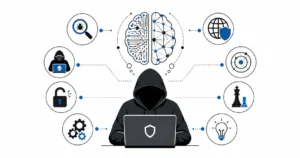
What makes a hacker truly dangerous is not the tools they use – it is the way they think. While most people look at a system and ask “how do I use this?”, a hacker asks “how do I break this?” This shift in perspective defines the hacker mindset in cyber security, and it is the same mindset that great defenders must develop to stay one step ahead of attackers.
Who Is a Hacker?
Hackers are not a single type of person. They exist across a spectrum defined by intent, not skill.
- Black Hat Hackers – malicious actors who exploit systems for financial gain, data theft, or disruption, with no authorization.
- White Hat Hackers – ethical security professionals who use the same techniques but with permission, to find and fix vulnerabilities.
- Grey Hat Hackers – operate between the two, sometimes breaking into systems without permission but without harmful intent.
- Nation-State Hackers – government-sponsored groups conducting large-scale espionage and infrastructure attacks.
Regardless of category, all effective hackers share a common mental framework – a disciplined, creative, and patient way of approaching systems and people.
The Core Traits of the Hacker Mindset
- Relentless Curiosity: Hackers never stop at “it works.” They dig into why it works and what happens when it fails – discovering vulnerabilities others overlook.
- Systems Thinking: They see the full picture. A weakness in a third-party vendor, a reused employee password, or a forgotten subdomain can be the entry point into an entire organization.
- Patience: Most serious attacks take weeks or months of quiet reconnaissance before a single malicious action is taken.
- Creative Problem Solving: Security systems are built on assumptions. Hackers violate those assumptions in ways designers never anticipated – chaining small flaws into devastating exploits.
- Knowledge of Human Psychology: Technology is hard to crack; humans are easier. Social engineering – phishing, pretexting, impersonation – rem.
How Hackers Plan an Attack
Skilled attackers follow a structured process, not unlike a military operation:
- Reconnaissance: Gathering intelligence on the target – employee names, email formats, technologies, open ports – using passive tools that leave no trace.
- Scanning: Actively probing for open services, software versions, and misconfigurations to map the attack surface.
- Gaining Access: Exploiting a discovered vulnerability – whether a software flaw, a stolen credential, or a clicked phishing link.
- Maintaining Access: Planting backdoors and hidden accounts to ensure persistence even after the original entry point is closed.
- Lateral Movement and Exfiltration: Moving quietly through the network, escalating privileges, and extracting data slowly enough to avoid detection – then wiping all traces.
Why Defenders Must Think Like Hackers
The best security professionals are those who have internalized the attacker’s perspective. Penetration testing, red teaming, and threat modeling are all built on this principle – you cannot defend against what you cannot imagine. When security teams adopt the hacker mindset in cyber security, they stop building walls based on what they assume attackers will do, and start building them against what a creative, motivated adversary could do.
This mindset shift improves security at every level – from how developers write code, to how employees recognize manipulation attempts, to how architects design resilient networks. To know about more visit this page-Cozonix.
Conclusion
The most dangerous hackers are not the ones with the best tools – they are the ones with the sharpest minds. Understanding the hacker mindset in cyber security is not about glorifying attacks. It is about closing the gap between how defenses are built and how attackers actually think. In a threat landscape that evolves daily, thinking like your adversary is no longer optional – it is your strongest defense. If you want to learn more visit this page.
Understanding the hacker mindset in cyber security is essential for staying one step ahead of modern threats. By learning how attackers think, identify vulnerabilities, and exploit weaknesses, individuals and businesses can build stronger, more resilient security systems. Developing this perspective not only enhances defensive strategies but also opens the door to a successful career in cyber security.